
AI-Powered Car Damage Detection from Photos
Aviasole Technologies - Internal R&D / Innovation Prototype
We built an AI system that looks at a photo of any vehicle and instantly identifies what is damaged - dents, scratches, broken glass, collision damage - with bounding boxes and confidence scores. No human review needed.
The Idea
Someone on our team asked a simple question: could an AI look at a photo of a damaged car and tell you exactly what’s wrong with it - the way an assessor would, but in seconds?
We built a working answer to that question. Upload any vehicle photo. The system analyses it, draws boxes around every area of damage, names what it found, and gives you a confidence score for each finding.
What It Detects
The model was trained to recognise 14 specific types of vehicle damage:
Collision damage - front collision, rear collision, side collision, severe damage
Body damage - dent, scratch, crack, bumper damage, hood damage, mirror damage
Glass & safety - windshield damage, glass shatter
Other - tire flat, lamp broken
This level of specificity matters. Knowing a car has “damage” is not useful. Knowing it has a side collision with a broken mirror and a cracked windshield is exactly what an assessor, insurer, or fleet manager needs.
How It Works
The system runs two detection passes on every image:
Pass 1 - original image: The AI analyses the photo as-is to catch obvious damage.
Pass 2 - AI-enhanced image: The photo is upscaled 3x using a super-resolution model (FSRCNN), with contrast enhancement applied, then re-analysed. This second pass catches damage that was too subtle or small to detect in the original - scratches, hairline cracks, minor dents.
You get both results side by side, so nothing gets missed.
Live Detection Results
Side Collision - Dent, Mirror Damage, Severe Damage Detected
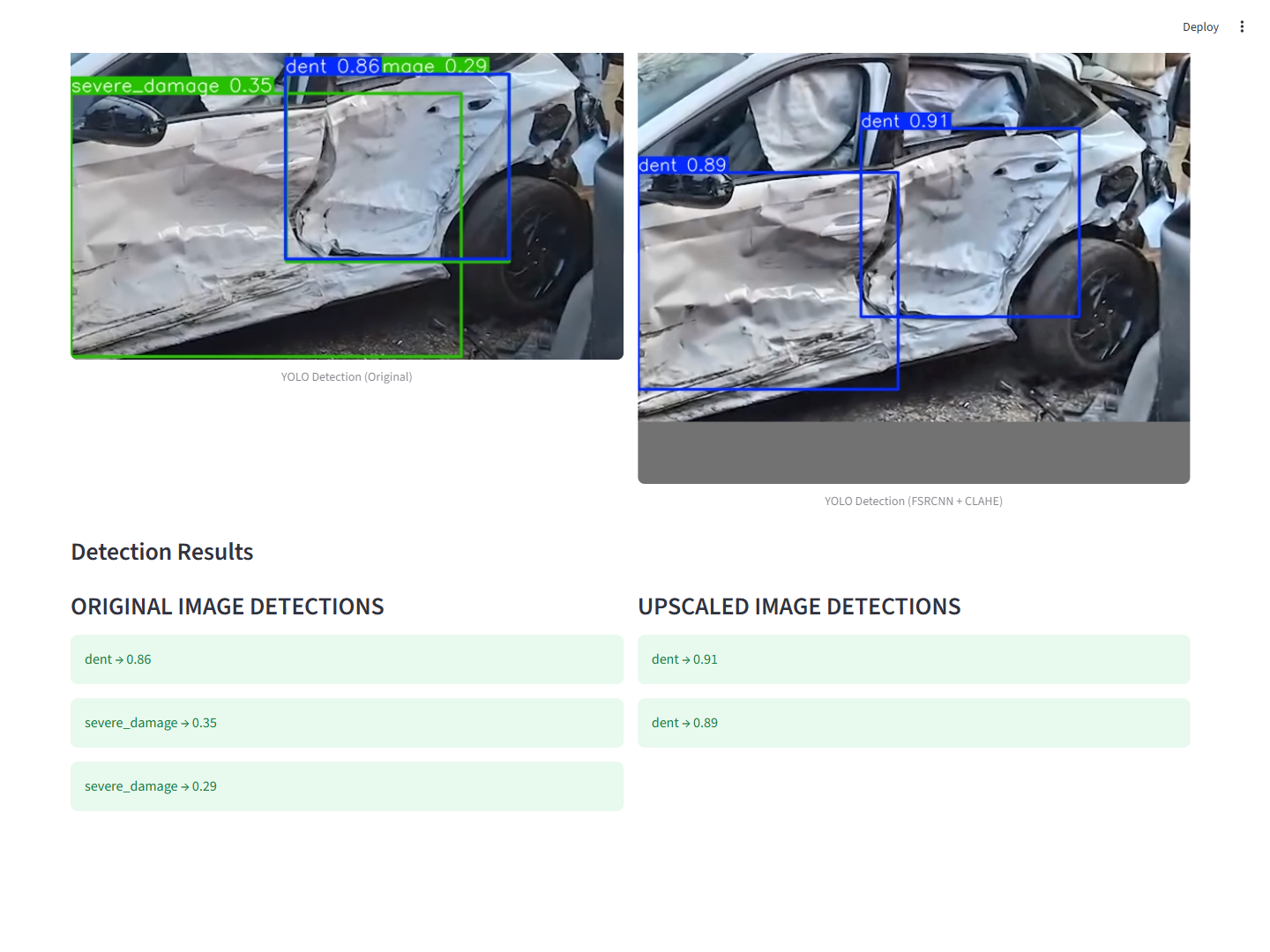
The AI correctly identified the extensive side panel damage, flagging dents across multiple zones and mirror damage - matching exactly what a human assessor would report on this vehicle.
Front Collision - Severe Damage, Dent, Glass Shatter Detected
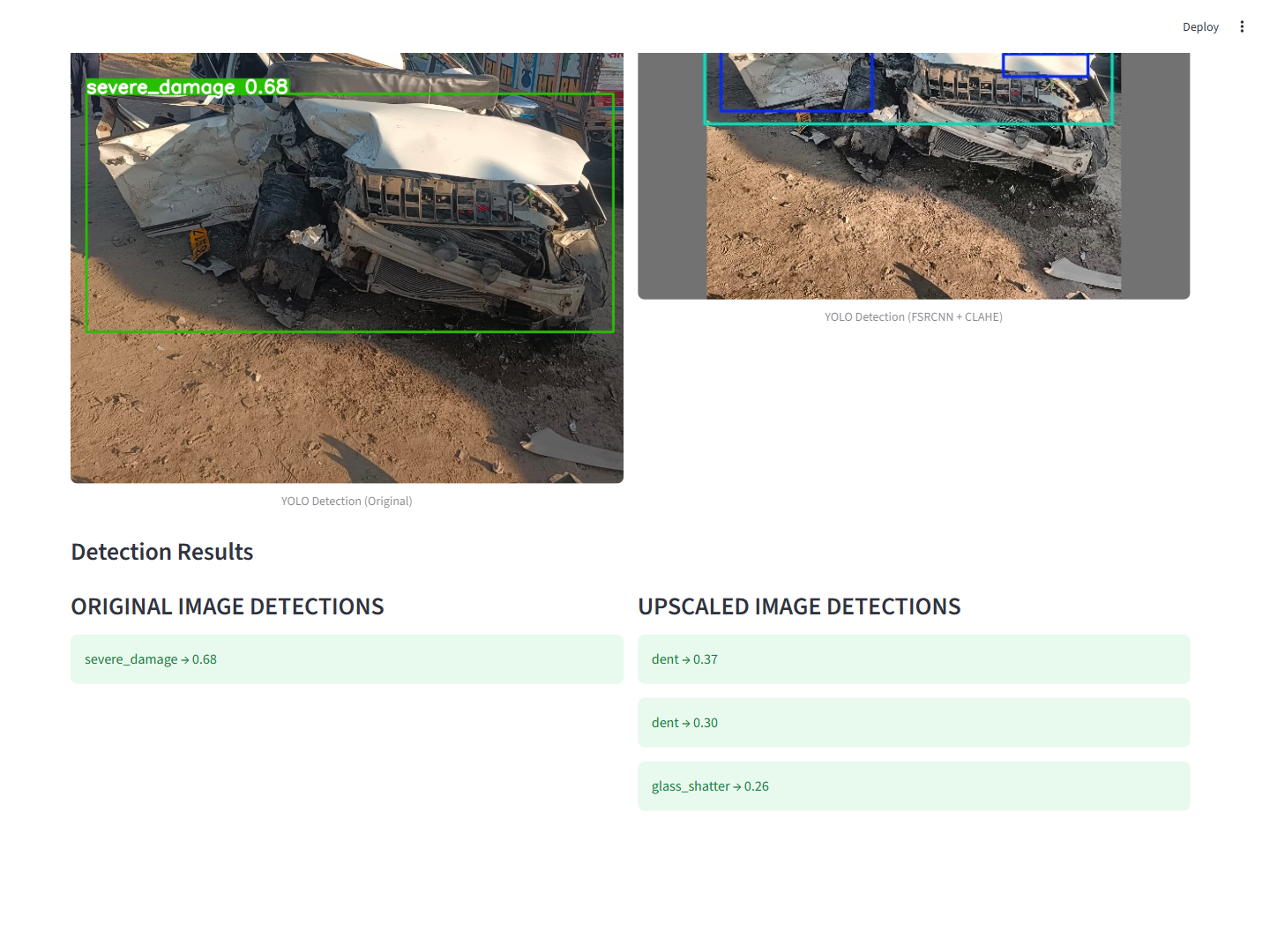
On this severely damaged vehicle, the model detected the front collision, identified multiple dent zones across the crumpled hood, and flagged glass shatter - all from a single photo, in under 10 seconds.
Who Would Use This
Insurance companies are the most obvious fit. Right now, a claim requires a human assessor to visit the vehicle, document the damage, and write a report. That takes days and costs money. This system can produce a damage report from a photo in seconds - either replacing that visit entirely or flagging which claims need human review versus which can be settled automatically.
Fleet operators need to track vehicle condition across hundreds of cars. Manual inspection at every return is expensive and inconsistent. A photo-based AI check catches damage the person returning the vehicle might not even mention.
Car rental companies face the same problem at scale. A quick photo at pickup and return, automatically compared by an AI, immediately flags any new damage before the customer leaves the lot.
Auto repair workshops can use the system to speed up initial damage scoping - take a photo, get a preliminary assessment, give the customer a faster quote.
What Comes Next
This prototype runs on standard hardware - no expensive GPU required. It can be embedded into a mobile app, integrated into an existing claims platform as an API, or deployed as a web tool for assessors in the field.
The model can also be fine-tuned on specific vehicle types - commercial trucks, motorcycles, fleet vehicles - to improve accuracy for a particular use case.
If you are dealing with vehicle damage assessment at any scale, we would like to show you what this looks like in your workflow.